Chantilly, Macramé or Guipure Lace: Which Should You Choose for a Formal Event?
Choosing between Chantilly, macramé and guipure lace means deciding more than the pattern of a dress: it also determines lightness, structure and formality. Chantilly is fine, sheer and fluid; macramé has a more tactile appearance with visible knotted textures; guipure connects substantial motifs without a continuous mesh ground, creating a bolder effect. None is universally better. The right choice depends on the season, time of day, dress silhouette and desired impression. Comparing the lace construction, lining and drape at close range is the most reliable way to choose with confidence.
Chantilly, macramé and guipure: the differences at a glance
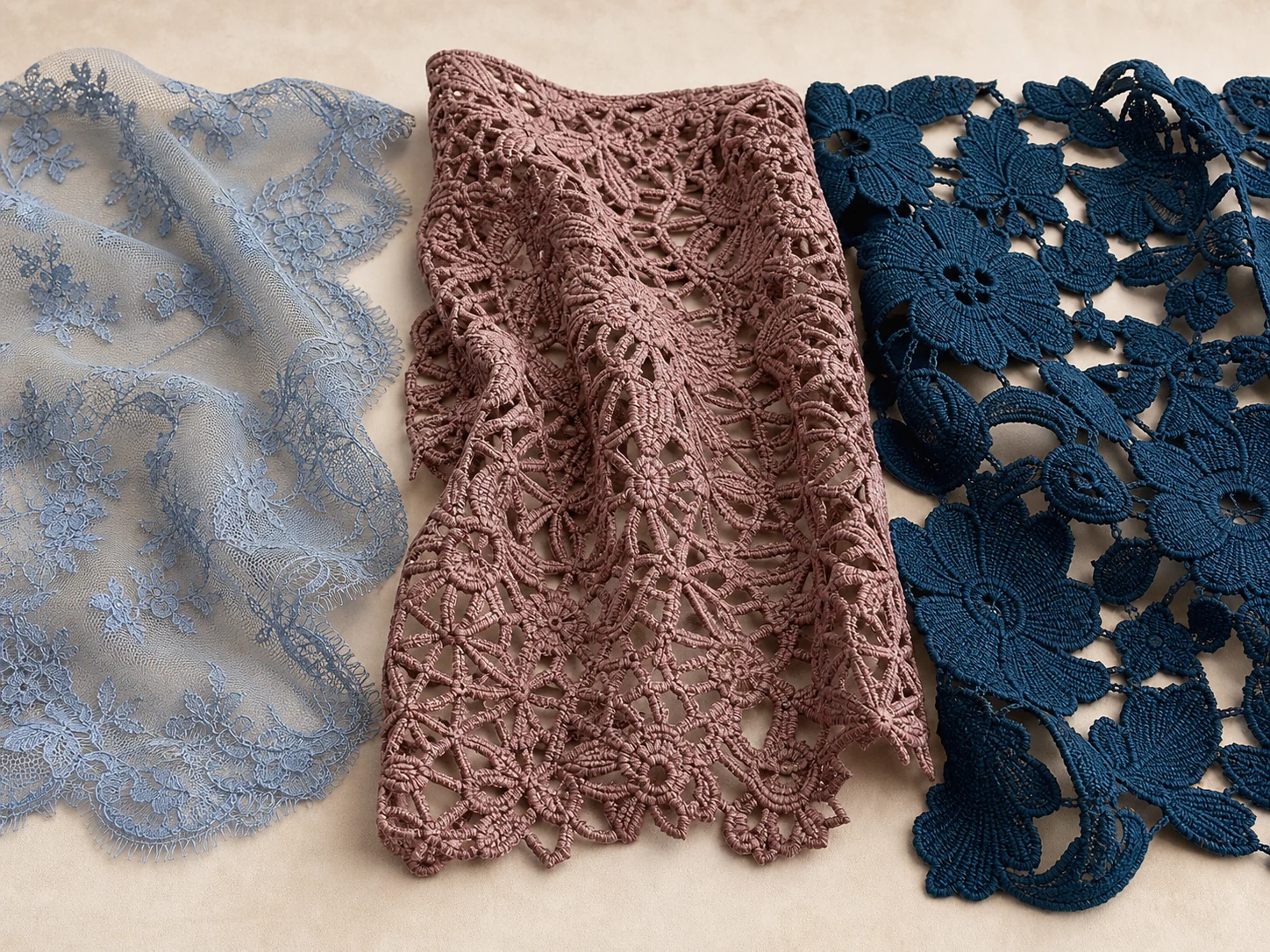
The simplest way to distinguish these laces is to examine the ground. Chantilly motifs sit on an extremely fine, almost weightless net. In guipure, flowers and other shapes are connected directly by bars or small bridges, with no continuous mesh underneath. Macramé is created through knotting and, in fashion terminology, commonly describes openwork textiles with a substantial, handcrafted appearance.
The construction changes how the material behaves. Chantilly follows movement and works beautifully in light overlays; macramé brings texture to the foreground; guipure holds a defined line more readily. To compare these effects on complete garments, examine formal dresses with lace and note where the lace is placed and which fabric supports or complements it.
| Lace type | How to recognise it | Effect on a dress | Well suited to |
|---|---|---|---|
| Chantilly | Fine net, delicate motifs, often scalloped edges | Light, fluid and romantic | Overlays, sheer sleeves and refined events |
| Macramé | Visible knots or cords and tactile openwork | Bold, contemporary and textured | Bodices, inserts and modern occasion looks |
| Guipure | Motifs joined by bridges, with no mesh ground | Structured, graphic and striking | Sheath dresses, decorative panels and defined lines |
Commercial names do not always describe textile techniques precisely. Before buying, consider close-up photographs, fibre composition, stated stretch, lining and the way the complete garment fits—not the label alone.
When to choose Chantilly lace: lightness and transparency
Chantilly lace is recognised by its fine net ground and delicate motifs, often inspired by flowers and foliage. Its defining quality is lightness: it follows the body without creating a rigid surface and can form sleeves, necklines or back panels with a softly veiled effect. Layered over a tone-on-tone lining, it looks subtle; placed over a slightly contrasting base, its pattern becomes more visible.
It is an effective choice when you want delicate elegance, particularly for daytime celebrations, spring or summer receptions and dresses with flowing skirts. This does not limit it to daylight. On a long dress, paired with a dark base or restrained luminous details, Chantilly can look highly sophisticated at an evening event.
The fine net requires care. Seams, lingerie and lining edges may be easier to see, while jewellery settings, rough handbags or projecting fastenings can catch the fabric. During a fitting, move your arms and torso, sit down and inspect the dress in natural light. The level of transparency seen in a fitting room can change outdoors or in flash photography.
When to choose macramé: texture and contemporary character
Macramé is traditionally made by knotting threads or cords. In occasionwear, the term is also widely used for openwork laces with clearly defined motifs, perceptible thickness and an appearance that is less ethereal than Chantilly. The surface becomes a central part of the design: even a limited insert can give character to a bodice, sleeve or waistline.
It works particularly well on contemporary dresses and in combinations with chiffon, crêpe or smooth satin. The contrast between a tactile section and an even surface makes the garment’s construction easy to appreciate. Small tone-on-tone motifs look restrained, whereas large interlaced patterns, pronounced borders or contrasting linings create a more assertive result.
Before choosing it, assess how it feels against the skin. A firm edge near the underarm, neck or décolletage can become uncomfortable after several hours. Check thickness at the seams too: several overlapping layers may alter the fit. The success of the dress therefore depends on the balance between lace, lining and cut, not on the motif alone.
When to choose guipure: defined motifs and greater structure
Guipure is distinguished by motifs connected with bars or plaits rather than worked onto a continuous net ground. Open spaces make flowers, leaves or geometric forms stand out, creating a more graphic surface. Compared with Chantilly, it generally has more body, so it can support decorative panels, defined bodices and silhouettes that need visual presence.
It is a strong option when a dress needs to express elegance through a clear design statement. On a sheath dress, guipure can build a rich surface without beads; on a skirt or bodice, it can occupy selected areas while a more fluid fabric supplies movement. Lining changes the result significantly: a matching colour makes the pattern look compact, while a controlled contrast highlights the open spaces.
Dense guipure may feel heavier and less yielding, but this is not universal. Fibre content, motif scale and stretch vary considerably between garments. It is therefore unwise to choose by name alone. Detailed photography helps, but trying on lace occasion dresses in different styles shows whether the structure supports your silhouette without restricting movement.
How to choose lace for the event, season and dress shape
Begin with the effect you want. If your priority is a light, romantic dress that moves easily, evaluate Chantilly first. If you prefer a visible, contemporary texture, macramé brings more character. If you want crisp motifs and a structured surface, guipure is often the most coherent option.
- For a daytime ceremony: consider lighter constructions, moderately sized motifs and opaque linings in balanced colours.
- For an evening event: more defined lace, deeper shades and controlled sparkle can work well, provided accessories remain refined.
- In warm weather: check overall weight, fibre content and lining breathability; openwork alone does not guarantee coolness.
- On a flowing silhouette: lightweight lace or lace restricted to the bodice preserves the movement of the skirt.
- On a close or geometric cut: guipure and more substantial lace can emphasise construction if they still allow comfortable sitting and walking.
Motif scale matters too. Very large patterns direct attention to the area where they are placed, while smaller motifs create a more even visual field. Seam placement, lining colour and the amount of visible skin can be as influential as the lace family. Make the final decision on the complete dress rather than on an isolated swatch.
To move from comparison to selection, explore the collection of evening dresses with lace details, including all-over treatments, decorated bodices and combinations with fluid fabrics. Comparing two or three styles while wearing the same lingerie and the intended heel height gives a more reliable view of transparency, proportion and comfort.
Frequently asked questions about Chantilly, macramé and guipure
Which lace is the lightest for a formal dress?
Chantilly is generally the lightest of the three because of its fine net ground. Actual comfort also depends on fibre content, embroidery, the number of layers and the lining. A Chantilly overlay on a heavy base may feel warmer than a dress with one limited guipure insert.
What is the main difference between Chantilly and guipure?
Chantilly has motifs worked on a fine net, whereas guipure has no continuous net ground: its motifs are connected by bars or small bridges. Chantilly consequently appears more delicate and fluid, while guipure looks more substantial and structured.
Are macramé and guipure the same?
No. Macramé is properly a knotting technique. Guipure is a family of continuous laces without a mesh ground, with motifs joined to one another. Retail terminology can be flexible, so always inspect the garment’s actual construction rather than relying exclusively on its product name.
Which lace works best on a long, flowing dress?
Chantilly naturally complements soft silhouettes because it is light. Macramé or guipure can also work beautifully when concentrated on the bodice or in carefully placed inserts, leaving chiffon, georgette or another fluid fabric to form the skirt.
How can I tell whether lace will remain comfortable for hours?
Check edge softness, stretch, lining and every point touching the neck, underarms and arms. Sit down, raise your arms and walk during the fitting. A beautiful motif that feels firm or abrasive in movement zones can become uncomfortable over a long celebration.